LLM SEO tools, and how to tell if their numbers are real
By Michael Nefedov, noetio · Updated 21 October 2026
LLM SEO tools check whether ChatGPT, Gemini, Perplexity and Google's AI answers name your business. Their numbers are only as good as the way they collect the answers.
Short answer
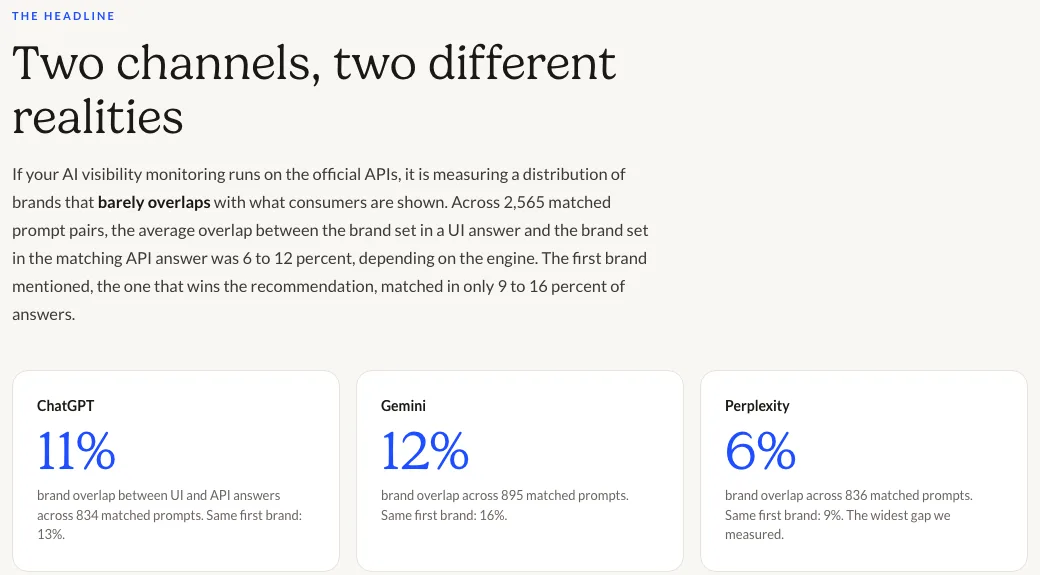
- The API and the real ChatGPT app give different answers to the same question. One study found only 6 to 12% overlap.
- None of the 4 vendor pages we read says how many runs it does per question. Only Peec says whether its app view is logged in or out.
- Before you pay, ask the 8 questions below.
The API and the real app disagree
The API and the app give different answers to the same question. A tool can ask an engine in 2 ways:
- through the developer API
- through the app people use, like chatgpt.com
6-12%
average overlap between the brands the API and the app named, depending on the engine: ChatGPT 11%, Gemini 12%, Perplexity 6%. 900 unbranded World Cup questions.
Brandlight Research Lab, June 2026, 2,565 matched answer pairs. Source
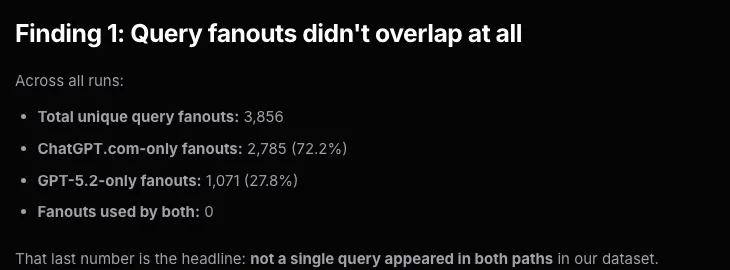
0
of 3,856 unique query fan-outs (the searches the model ran) were used by both chatgpt.com and the GPT-5.2 API. 3,645 conversations over 27 days.
Genezio, 4 February 2026, UK banking questions. Source
Both studies come from companies that sell AI visibility tools.
What else can change the answer
Where you ask, and how often, can change who gets named. Vendors rarely say how they handle it.
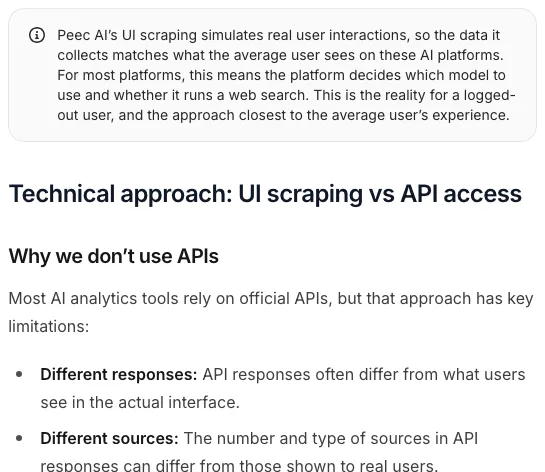
- Logged in or out. Peec says its app view is the “reality for a logged-out user”, where the platform picks the model and decides whether to search the web (Peec docs).
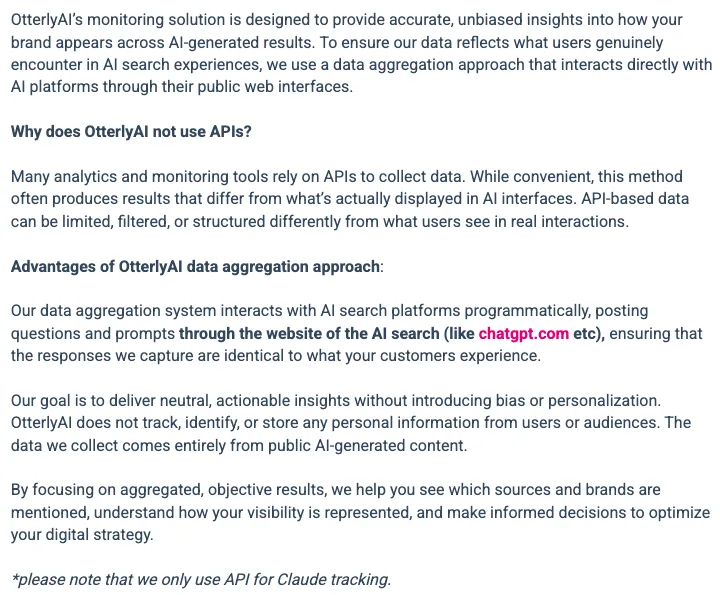
- Country and language. Otterly says AI search results “can differ significantly by region” and lets you set a country per prompt (Otterly help).
- Number of runs. None of the four vendor pages below says how many runs it does per question.
We have no published test of our own on these points, so we do not give numbers.
How LLM SEO tools collect answers
Three of the four trackers below say they collect from the real app or browser; Scrunch says it mixes methods. In each vendor's own words, read 21 October 2026:
| Tool | Method, in their words |
|---|---|
| Peec AI | The web app, because “API responses often differ from what users see” (docs) |
| Otterly.AI | Each platform's website; “only use API for Claude tracking” (help) |
| Profound | “From the consumer browsing experience” (site) |
| Scrunch | “including browser automation and official platform APIs” (FAQ) |
What none of them say: how many runs per question. Only Peec says whether its app view is logged in or out.
Prices and what each tracker covers: Profound alternatives compared. To pick a tool by job, see best AI SEO tools.
8 questions to ask an LLM SEO tool before you pay
If a vendor cannot answer these eight, treat its numbers as a guess.
- 1Real app or API, and for which engine?
- 2Logged in or logged out?
- 3Which model, and do you tell me when it changes?
- 4How many runs per question?
- 5Which country and language per question?
- 6Can I see the raw answers and cited pages?
- 7Is a blocked run counted as not named?
- 8Can I add a control question?
LLM SEO: what gets you named
Three basics get you named: be indexed, let the bots in, answer one question per page.
- Be indexed. Google says a page must be “indexed and eligible to be shown in Google Search with a snippet” to be a link in AI Overviews (Google).
- Let the bots in. OpenAI says sites opted out of OAI-SearchBot “will not be shown in ChatGPT search answers, though can still appear as navigational links” (OpenAI).
- Answer one question per page, clearly, with sources. More in SEO vs GEO.
Sources
- The API tells you one story. Your customers see another., Brandlight Research Lab, June 2026. Read 21 October 2026.
- Zero query overlaps between GPT-5.2 (API) and ChatGPT.com, Genezio, 4 February 2026. Read 21 October 2026.
- Intro to Peec AI, Peec AI docs. Read 21 October 2026.
- How OtterlyAI collects data, Otterly.AI help center. Read 21 October 2026.
- Official information about Profound, Profound. Read 21 October 2026.
- What methods does Scrunch use to collect data from AI platforms?, Scrunch FAQ. Read 21 October 2026.
- AI features and your website, Google Search Central, last updated 10 December 2025. Read 21 October 2026.
- Overview of OpenAI Crawlers, OpenAI. Read 21 October 2026.
Compass, our AI SEO agent, is designed to measure AI answers this way: API runs for the trend, and checks in the real app for the number that counts. It is not open yet.
Questions
Yes. For AI answers that search the web, the basics are the same as SEO: the page must be indexed, crawlable by the engine's search bot, and answer the question clearly. Google says there are no extra requirements to appear in AI Overviews or AI Mode. What changes is how you measure it, because the answers move between runs.
We found no independent test of how accurate any tracker is. Every study we found comparing the API with the real app was published by a vendor. So pick by method: real app or API, logged in or out, how many runs, which country, and whether you can see the raw answers.
Yes, by hand. Open ChatGPT logged out in a temporary chat, start a new chat for every run, ask the same unbranded question 3 times and write down how many times you were named. Do the same for a control question. It is slow, but it measures what a buyer sees.
Turn your next topic into a useful page
Compass reads your website, helps you plan relevant topics and creates sourced article drafts. Review and approve the work, then send it to a connected CMS or export it.
Written by Michael Nefedov, founder of noetio. Updated 21 October 2026.