SEO vs GEO: what's different, and what stays the same
By Michael Nefedov, noetio · Updated 21 October 2026
SEO vs GEO: for Google's AI answers it is mostly the same work. A few things differ, and they are listed below.
Short answer
- Mostly no. Google says there are no extra requirements to appear in AI Overviews or AI Mode.
- What differs: other crawlers read your site, third-party sites matter more, and AI answers are harder to measure.
- Cited pages in the top 10 went from 76% to 38% in two Ahrefs studies that are not directly comparable. AEO means the same work as GEO.
SEO vs GEO: the comparison
The goal differs: SEO ranks a link, GEO gets you named inside an answer.
| SEO | GEO | |
|---|---|---|
| Goal | Rank in a list of links | Be named or cited inside an answer |
| Google's rule | Indexed, shown with a snippet | The same rule for AI Overviews and AI Mode |
| Who reads your site | Googlebot, Bingbot | Also OAI-SearchBot, PerplexityBot |
| Keyword stuffing | Against Google's spam policies | “Little to no improvement” in the GEO paper |
| Measuring | Rank and clicks, fairly stable | Answers change between runs: count k of n |
| Third-party sites | Links help | Reddit, LinkedIn, YouTube and media are cited directly |
SEO
Getting your pages to rank in search results like Google and Bing.
GEO
Generative engine optimization: being named or cited in AI answers. From a 2023 research paper.
AEO
Answer engine optimization. No single official definition: snippets, voice and AI answers.
What Google says about AI Overviews and SEO
“The best practices for SEO remain relevant for AI features in Google Search.”
So for Google, GEO is SEO. The full “no additional requirements” quote is in how to rank in AI Overviews.
- A page “must be indexed and eligible to be shown in Google Search with a snippet” to be a supporting link.
- Both features may use “query fan-out”: many related searches on subtopics to build one answer.
Google's newer guide says the same. Its guide to optimizing for generative AI features (last updated 10 July 2026) says: “From Google Search's perspective, optimizing for generative AI search is optimizing for the search experience, and thus still SEO.”
It adds one condition to the older page: “a site must be included in Search generative AI features in Search Console to be eligible for display in generative AI features on Google Search”. Check the Generative AI performance report in your Search Console.

Does ranking in Google mean being cited?
Ranking in the top 10 may help less than a year ago. Two Ahrefs studies on Google AI Overviews:
Cited in Google AI Overviews. Two studies by Ahrefs with different methods, so not a clean trend.
- July 202576%1.9 million citations from 1 million AI Overviews (top 3 citations of each)
- 2026 update38%863,000 keywords, 4 million AI Overview URLs
Sources: Ahrefs, “76% of AI Overview Citations Pull From the Top 10”, 21 July 2025; Search Engine Journal, report on the Ahrefs update, 2 March 2026. Read 21 October 2026.
Ahrefs says the method changed too, so the two numbers are not directly comparable and do not show a clean trend. It points to fan-out as one reason: a page can be cited because it ranks for a subtopic, not the main question. Pages that answer one narrow question well gain.
What the GEO paper found
The paper points to specific, sourced writing, not tricks. The original GEO paper tested 9 ways of rewriting pages on GEO-bench, a set of 10,000 queries (the methods were scored on the 1,000-query test part), in its own test engine:
40%
up to 40% is the paper's best result on its own benchmark (GEO-bench); on Perplexity.ai it reports up to 37%. Both were tested in 2023, not on today's ChatGPT. The paper found citing sources, quotes and statistics worked best.
Aggarwal et al., KDD 2024 (arXiv v3, 28 June 2024). Source
115%
more visibility from the Cite Sources method, for sites ranked fifth in the results. For the top-ranked site the same method cut visibility by 30.3% on average.
Same paper, Table 2 and section 4. Source
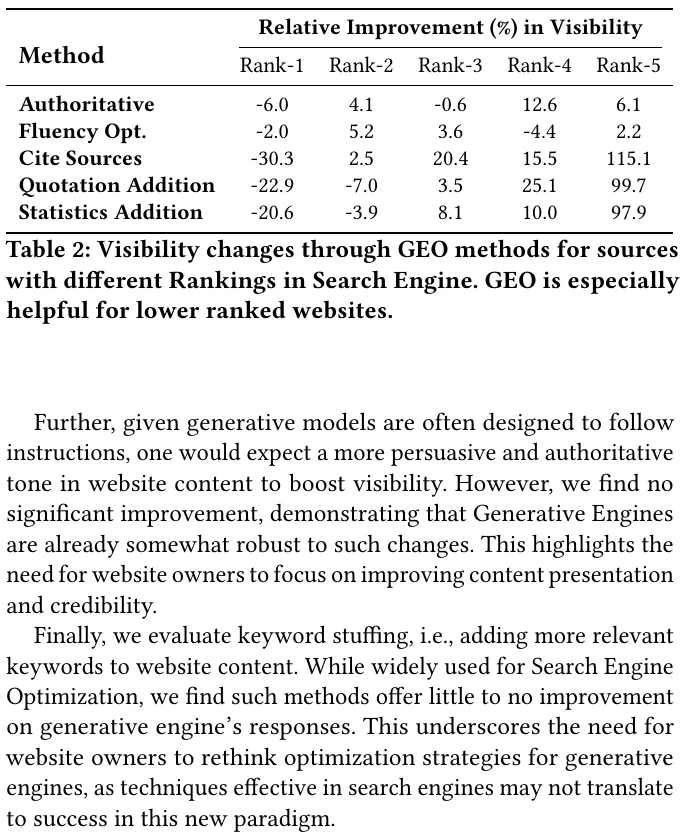
An authoritative tone gave “no significant improvement”, keyword stuffing “little to no improvement”. It's a lab test from 2023 and 2024, not today's ChatGPT. Read it as direction: be specific, cite sources, use real numbers.
Where GEO is different from SEO
Three things differ: more bots read your site, third-party sites matter more, and measuring is harder.
Other crawlers read your site
| Bot | What it does |
|---|---|
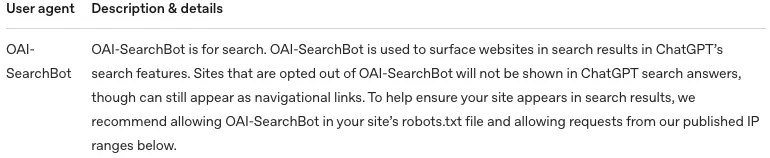
| OAI-SearchBotOpenAI | Finds pages for ChatGPT search. Opted-out sites “will not be shown in ChatGPT search answers, though can still appear as navigational links” (OpenAI) |
| GPTBotOpenAI | Crawls content “that may be used in training” OpenAI's models (OpenAI) |
| PerplexityBotPerplexity | Shows and links websites “in search results on Perplexity” (Perplexity) |
Third-party sites carry more weight
Semrush tracked 230,000 prompts weekly for 13 weeks (14 July to 12 October 2025) across ChatGPT search, Google AI Mode and Perplexity. Values are the study's rounded figures for ChatGPT.
- Early August 2025about 60%
- Mid-September 2025about 10%
Source: Semrush, “The Most-Cited Domains in AI: A 3-Month Study”, 28 October 2025. Read 21 October 2026. Sources move fast.
Reddit and LinkedIn were among the top five most-cited domains on ChatGPT search, Google AI Mode and Perplexity in the same study (Semrush). Reddit stayed ChatGPT's second most-cited domain after the drop.
Measuring is harder
A rank is one number. An AI answer changes between runs, between the app and the API, and between logged in and out. See how LLM SEO tools measure, and compare the trackers in Profound alternatives.
What to do
Keep doing SEO, then add six small checks.
- 1Keep doing SEO. For Google's AI answers it is the same work.
- 2Allow OAI-SearchBot and PerplexityBot in robots.txt.
- 3Keep your site in Bing Webmaster Tools.
- 4Write one clear page per buyer question, with sources.
- 5Get mentioned honestly on Reddit, LinkedIn, YouTube and media.
- 6Measure AI answers with several runs, not one screenshot.
Want this done for you? See what SEO automation can do.
Sources
- AI features and your website, Google Search Central, last updated 10 December 2025. Read 21 October 2026.
- Optimizing your website for generative AI features, Google Search Central, last updated 10 July 2026. Read 21 October 2026.
- GEO: Generative Engine Optimization, Aggarwal et al., arXiv 2311.09735 (v3, 28 June 2024), KDD 2024. Read 21 October 2026.
- 76% of AI Overview Citations Pull From the Top 10, Ahrefs, 21 July 2025. Read 21 October 2026.
- Google AI Overview citations from top-ranking pages drop sharply, Search Engine Journal, 2 March 2026 (reports Ahrefs' 2026 update; the Ahrefs original was not found). Read 21 October 2026.
- The Most-Cited Domains in AI: A 3-Month Study, Semrush, 28 October 2025. Read 21 October 2026.
- Overview of OpenAI Crawlers, OpenAI. Read 21 October 2026.
- Perplexity Crawlers, Perplexity docs. Read 21 October 2026.
Questions
No. Google says the best practices for SEO remain relevant for AI Overviews and AI Mode, and a page must be indexed in Google Search to be cited there. GEO adds work on top of SEO: other engines' crawlers, measuring answers, and being mentioned on the sites AI answers read.
GEO, generative engine optimization, has a clear source: a 2023 research paper about being visible in AI-generated answers. AEO, answer engine optimization, has no single official definition. People use it for featured snippets, voice answers and AI answers. We treat the two words as the same work.
You need a few separate checks, not a separate strategy. Allow the AI search crawlers, measure AI answers with several runs, and build mentions on third-party sites. The pages themselves are the same pages you write for SEO.
More guides
- SEO for SaaS: A Plain Plan for Founders (2026)
- SEO for Startups: Your First 30 Days, Week by Week
- How to get your website to show up on Google
- Agentic SEO: what it is and how it works
Turn your next topic into a useful page
Compass reads your website, helps you plan relevant topics and creates sourced article drafts. Review and approve the work, then send it to a connected CMS or export it.
Written by Michael Nefedov, founder of noetio. Updated 21 October 2026.