SEO for startups: your first 30 days, week by week
By Michael Nefedov, noetio · Updated 20 October 2026
SEO for startups can start in one month: get crawled, publish 5 pages that match real searches, get listed, and measure. Google does not guarantee indexing, and ranking takes longer.
Short answer
- Week 1: get crawled. Week 2: 5 pages. Week 3: listings. Week 4: measure.
- Tools: Google Search Console and Bing Webmaster Tools.
- Do not expect rankings in 30 days. Most pages need longer (data in SEO for SaaS). The schedule is our plan.
Week 1: get your startup site indexed
If Google does not know your pages, nothing else matters, so do these six steps in order.
- Open a Search Console property for your domain and verify it.
- Check that no page has a stray
noindex, and thatrobots.txtdoes not block the site. A setting copied from a staging site can cause this. - Build a sitemap with every page you want indexed, with full URLs. Google ignores
priorityandchangefreq(Google). Submit it in Search Console. - Use URL Inspection on your home page and key pages, and request indexing. Google says this does not guarantee inclusion, and crawling can take a few days to a few weeks (Google).
- Link every page from another page, so crawlers have a path to it.
- Add the site to Bing Webmaster Tools too.

priority and changefreq. Source: Google Search Central, Build and submit a sitemap (last updated 8 July 2026), captured 21 October 2026. Open full size.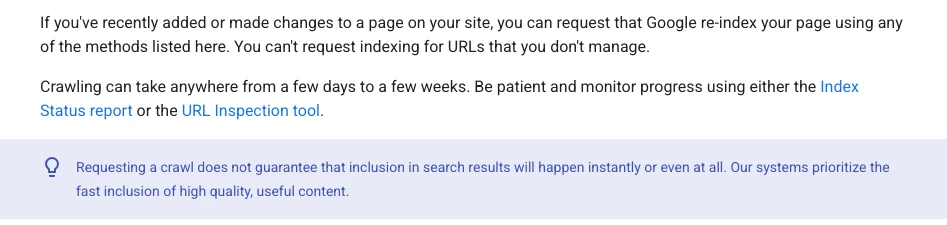
Full steps are in how to get your website on Google. If your site is built with code, also read Next.js SEO or Astro SEO. On Lovable, check Lovable SEO.
Week 2: write 5 pages that match real searches
Pick searches where the person is close to buying.
Edward Sturm calls these compact keywords: specific, purchase-oriented, with lower competition than broad ones (Sturm, “SEO – Down the Funnel”, 14 April 2024). That is his view, and he sells a paid program on these keywords. Specific searches are a reasonable start for a new site.
How to pick 5 keywords
- Type what your customer would type into Google. Note the autocomplete.
- Look at your competitors' pages. Their titles and H1s show the keywords they chose.
- Choose searches that name your problem or a tool you replace, not a broad topic.
- One keyword per page. Two pages on one keyword compete with each other.
A possible first five:
- Your product page, for what you do.
- An alternatives page for the biggest competitor. See Profound alternatives for the format, and the alternatives hub.
- A use-case page for your best customer type.
- A second use-case or integration page.
- One guide that answers a question your buyers ask before they buy.
For each page, put the keyword at the start of the title and meta description, in the URL, in the H1 and in the first words of the page (this is our habit, not a Google rule).
Use plain words. Put a call to action at the top and the bottom. A buyer page can be short. The plan for what to build, in what order, is in SEO for SaaS.
Week 3: get listed and linked
Ask to be listed where your buyers already look. Do not buy links. A new domain has few links pointing to it:
- Your own profiles: LinkedIn company page, X, GitHub, your founder bio. Link to your site.
- Startup and software directories for your category, such as Product Hunt, G2 or Crunchbase. Read each one's rules first. Google lists “low-quality directory or bookmark site links” as link spam, so skip directories that exist only to sell links.
- Communities where you can answer a question and link to a page that really answers it. Disclose that it is your product.
- Partners and customers who will mention you. Ask one by one.
We do not know how much ranking value each directory passes, so judge each by the visitors and credibility it brings.
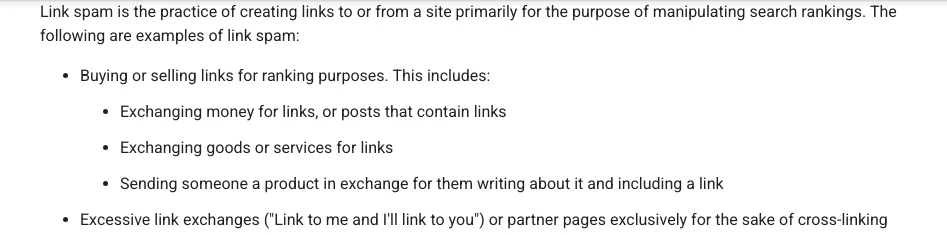
Never pay for links to pass ranking value: Google lists “buying or selling links for ranking purposes” as link spam (Google). Also link your new pages to each other and to your home page.
Week 4: measure what happened
On day 30, open Search Console, then Performance, and answer four questions. It shows clicks, impressions, average position and the queries that brought people (Google).
| Question | Where to look | What to do |
|---|---|---|
| Are my pages indexed? | Pages report, URL Inspection | Fix noindex, add links, resubmit |
| Do I get impressions? | Performance, set the range to 28 days (default is 3 months) | No impressions: wait, check indexing |
| High impressions, low clicks? | Performance, Pages tab | Rewrite the title to match the search |
| Which queries show up? | Performance, Queries tab | Write the next pages around them |
Source for the 3-month default: Search Console Help, Performance report, read 21 October 2026.
Do not expect big ranking changes in the first month. Ahrefs' data on how long pages take to reach the top 10 is in SEO for SaaS. Each month, add a few pages, fix weak titles and check weekly.
If nothing is indexed after two weeks
Read the reason URL Inspection gives, then fix links and content.
- Inspect a page with URL Inspection and read the reason it gives (blocked by robots.txt, noindex, or discovered but not indexed).
- Run the live test and look at the rendered HTML. If the text is missing, the page is built with JavaScript. See SEO for single page application.
- Add links to the page from your home page and from other pages. Then request indexing again.
- Check that the page says something the rest of your site does not.
Mistakes to avoid in month one
Most month-one mistakes waste time on volume instead of one good buyer page.
- Writing 20 broad blog posts before one buyer page exists.
- Changing URLs after you submit them. If you must, add a 301 redirect.
- Targeting one keyword with two pages.
- Checking rankings daily. Watch impressions in Search Console instead.
- Claiming results you do not have on the page. Use real numbers or none.
30-day SEO checklist for startups
If all eight are done on day 30, the plan is complete.
- 1Search Console verified, sitemap submitted
- 2No stray noindex, robots.txt open
- 3Bing Webmaster Tools added
- 45 pages, one keyword each, in the title, meta description, URL, H1 and first words
- 5Every page linked from another page
- 6A few honest listings or mentions
- 7Performance report checked on day 30
- 8Next 5 pages chosen from real queries
The page order for a SaaS site is in SEO for SaaS.
Sources
- Ask Google to recrawl your URLs, Google Search Central, last updated 10 December 2025. Read 21 October 2026.
- Build and submit a sitemap, Google Search Central, last updated 8 July 2026. Read 21 October 2026.
- Spam policies for Google web search, Google Search Central, last updated 28 August 2026. Read 21 October 2026.
- Performance report (Search), Search Console Help, Google. Read 21 October 2026.
- SEO – Down the Funnel, Edward Sturm, 14 April 2024. Read 21 October 2026.
Questions
Google says crawling can take anywhere from a few days to a few weeks, and a request does not guarantee inclusion. Ranking is a separate step and takes longer. No source can promise a date.
Not for this plan. The steps use free tools (Google Search Console, Bing Webmaster Tools), a sitemap, your own pages and profiles you create. Hire help when you have pages live and know what you want done faster.
This plan starts with the home page plus 5 pages that each target one specific search. The number 5 is our plan, not a rule from a source. We have no data on a best number.
No. Google's spam policies treat buying links to pass ranking value as link spam. Ask for honest listings and mentions instead.
More guides
- SEO for SaaS: A Plain Plan for Founders (2026)
- How to get your website to show up on Google
- Agentic SEO: what it is and how it works
- SEO vs GEO: what's different and what stays the same
Turn your next topic into a useful page
Compass reads your website, helps you plan relevant topics and creates sourced article drafts. Review and approve the work, then send it to a connected CMS or export it.
Written by Michael Nefedov, founder of noetio. Updated 20 October 2026.